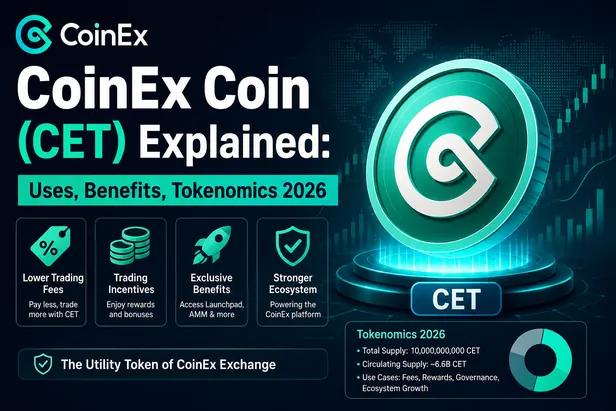
If you have come across CoinEx while researching cryptocurrency exchanges, you may also have noticed CoinEx Token (CET). But what is CET, what is it used for, and why does it matter within the CoinEx ecosystem?
CoinEx Token is designed as an ecosystem asset with practical uses that can include eligible trading-fee payments, fee discounts, VIP-related benefits, staking activities, and CoinEx Smart Chain utility. Understanding CET requires looking beyond its market price and considering its actual use cases, supply model, and ecosystem development.
This guide explains CoinEx Coin (CET) in simple terms, including its uses, benefits, tokenomics, supply model, utility, and risks.
What Is CoinEx Coin (CET)?
CoinEx Token (CET) is the native ecosystem token associated with CoinEx. It was introduced in 2018 and initially used the Ethereum ERC-20 standard. CET later became closely connected with CoinEx Smart Chain, where it serves as the network’s native asset.
Its main purpose is to provide utility within the CoinEx ecosystem rather than functioning only as a tradable cryptocurrency.
Major uses can include:
- Paying eligible trading fees with CET
- Receiving applicable fee discounts
- Supporting certain VIP benefits
- Participating in staking-related activities
- Paying gas fees on CoinEx Smart Chain
How Does CET Work?
CET has utility on both the CoinEx exchange and its blockchain ecosystem.
On the exchange, users can activate CET deduction for eligible trading fees. CoinEx states that using CET for eligible spot trading fees can provide a 20% discount, although certain products and markets have different rules.
On CoinEx Smart Chain, CET functions as the native gas asset and can be used for transaction costs and other blockchain-related functions.
Main Uses of CET
Trading-Fee Discounts
One of CET’s most practical uses is paying eligible trading fees. For applicable spot markets, CoinEx currently describes a 20% discount when users activate CET deduction.
This can be useful for active traders because small fee savings can accumulate over multiple transactions. However, the feature does not apply universally, so users should check the current fee rules.
VIP Benefits
CET holdings can contribute toward CoinEx VIP-level requirements. CoinEx’s fee information indicates that VIP qualification can involve factors such as CET holdings, total assets, and 30-day trading volume.
Therefore, simply purchasing CET does not automatically guarantee a particular VIP level.
CoinEx Smart Chain
CET is also the native asset of CoinEx Smart Chain. It can be used to pay gas and transaction-related costs and has a role in network participation, including validator and delegation functions.
Staking
CET can also be involved in staking-related activities within the CoinEx ecosystem. Staking involves delegating assets to validators, and rewards can depend on network and validator conditions.
Staking should not be treated as guaranteed income because rewards and risks can change.
CET Tokenomics Explained
Tokenomics describes a cryptocurrency’s supply, distribution, and mechanisms that can affect its circulating amount.
CoinEx states that CET originally had a total issuance of 10 billion tokens and that no additional issuance is planned under its current model.
A key part of CET tokenomics is its repurchase-and-burn mechanism.
CET Buyback and Burn
CoinEx states that 20% of daily trading-fee income is allocated to repurchase CET, with the repurchased tokens burned at the end of each calendar month.
The basic process is:
Trading-fee income → CET repurchase → CET burn → reduced supply
A burn permanently removes tokens from circulation. However, reduced supply does not automatically mean that CET’s market price will increase. Price still depends on demand, liquidity, market conditions, sentiment, and other factors.
What Are the Benefits of Holding CET?
CET’s benefits depend largely on how you use the CoinEx ecosystem.
Lower Eligible Trading Costs
Users trading eligible spot markets may reduce applicable fees through CET deduction.
Potential VIP Benefits
CET holdings can contribute toward certain VIP-level requirements alongside other criteria.
Blockchain Utility
CET has practical utility as the native gas asset of CoinEx Smart Chain.
Ecosystem Exposure
Holding CET provides exposure to the development and usage of the broader CoinEx ecosystem, although ecosystem growth is not guaranteed.
Is CET a Good Investment?
There is no universal answer. CET has identifiable utility, but it remains a cryptocurrency and can experience significant price volatility.
Before buying CET, consider:
- Whether you actually need its ecosystem utility.
- How much exposure you want to one exchange ecosystem.
- Whether you understand its supply and burn model.
- Whether you can tolerate substantial price movements.
- Whether you have reviewed the latest official CoinEx information.
Utility alone does not guarantee price appreciation.
Risks of CoinEx Coin (CET)
CET carries several important risks.
Market volatility: Its price can rise or fall significantly.
Ecosystem dependence: CET’s utility is closely connected to CoinEx and its related services.
Regulatory risk: Cryptocurrency rules can differ between countries and change over time.
No guaranteed growth: A burn mechanism or practical utility does not guarantee a higher market price.
Staking risks: Where staking is available, validator and network conditions can affect rewards.
How to Research CET Before Buying
Before purchasing CET, review its current supply, utility, fee benefits, burn mechanism, CoinEx ecosystem activity, and competing exchange tokens.
Also consider your own risk tolerance and avoid making a decision based only on the token’s current price or historical performance.
Final Thoughts
CoinEx Coin (CET) is designed as a utility-focused ecosystem token with functions across CoinEx and CoinEx Smart Chain. Its uses can include eligible trading-fee payments, fee discounts, VIP-related benefits, staking-related activities, and blockchain transaction fees.
Its 10-billion-token original issuance and repurchase-and-burn mechanism are important parts of its tokenomics. However, neither utility nor token burns guarantee price growth.
If you are considering CET, focus on its real-world utility, supply model, ecosystem adoption, costs, and risks rather than price alone. Always check the latest official information before making a financial decision.
Frequently Asked Questions
What is CoinEx Coin (CET)?
CoinEx Token (CET) is the native ecosystem token associated with CoinEx. It provides utility across CoinEx services and CoinEx Smart Chain.
What is CET used for?
CET can be used for eligible trading-fee payments, applicable fee discounts, certain VIP-related benefits, staking-related activities, and gas fees on CoinEx Smart Chain.
What is the total supply of CET?
CoinEx states that CET originally had a total issuance of 10 billion tokens and that no additional issuance is planned under its current model.
Does CET have a burn mechanism?
Yes. CoinEx states that 20% of daily trading-fee income is used for CET repurchases, with repurchased tokens burned monthly.
Can CET reduce CoinEx trading fees?
Yes, for eligible trading. CoinEx currently describes a 20% discount when CET deduction is used for applicable spot trading fees.
Is CET safe to buy?
CET carries cryptocurrency-related risks, including market volatility, regulatory uncertainty, ecosystem dependence, and liquidity considerations. Its utility does not guarantee that its price will rise.
Recent Post:
Pionex GPT: Powerful Guide to AI Trading Strategies, Bots & Automation in 2026
If you are exploring automated cryptocurrency trading after learning about CoinEx Coin (CET), our recent guide, Pionex GPT: Powerful Guide to AI Trading Strategies, Bots & Automation in 2026, explains how AI-focused trading tools and automated strategies work.
The guide covers AI trading strategies, bots, automation, and important considerations for traders who want to understand how these technologies can be used in cryptocurrency markets.