


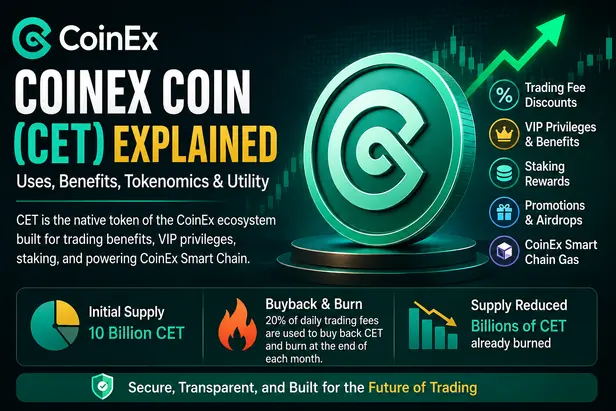
CoinEx Coin (CET) Explained means one simple point: CET is the native token of the CoinEx ecosystem, not merely a listed cryptocurrency. It has utility across CoinEx services and CoinEx Smart Chain.
CoinEx launched CET in January 2018. It was initially issued as an Ethereum ERC-20 token and later migrated to CoinEx Smart Chain, where it serves as the chain’s native fuel. This guide covers CET’s uses, supply model, burn process, and risks.
CoinEx Coin (CET) Explained: What Is CET?
CoinEx Token (CET) is the platform token of CoinEx. According to CoinEx, CET works as a value-added service and rights system within its business ecosystem. Its utility includes trading-fee deduction, VIP-related benefits, promotional activities, and blockchain transactions.
Utility and investment performance are different things. A token can have practical uses while its market price remains volatile.
CoinEx Coin (CET) Explained: Main Uses and Benefits
CET has several functions for users who interact with the CoinEx ecosystem.
CoinEx Coin (CET) Explained: Trading Fees
Eligible users can use CET to offset equivalent trading fees and receive applicable rate discounts. Conditions depend on current CoinEx rules, so check the latest fee schedule before assuming a discount.
CoinEx Coin (CET) Explained: VIP Benefits
CET holdings can contribute toward CoinEx VIP eligibility. CoinEx lists fee discounts, priority support and promotional privileges. VIP levels can also depend on assets and trading volume.
CoinEx Coin (CET) Explained: Staking and Promotions
CET is supported in certain staking services and ecosystem promotions. CoinEx has also described airdrop opportunities and other platform-related benefits for eligible holders. These are utility features, not guaranteed returns.
CoinEx Coin (CET) Explained: Tokenomics and Supply
The original CET supply was 10 billion. However, that figure should not be confused with the current supply. CoinEx’s latest CET information shows a much lower total supply after years of repurchases and burns.
CoinEx reported that, after its April 2026 burn, 2,493,474,969.96 CET remained. Its current CET page later reported additional 2026 burns, showing why supply figures should always be checked against the latest official data.
This matters because tokenomics change as burns continue.
CoinEx Coin (CET) Explained: How Buyback and Burn Works
CoinEx says it allocates 20% of daily trading-fee income to repurchase CET. The tokens repurchased during each calendar month are then permanently burned.
CoinEx publishes repurchase and burn records for verification.
However, a burn does not guarantee a higher CET price. Market demand, liquidity, market conditions, ecosystem activity and investor sentiment can all influence price.
CoinEx Coin (CET) Explained: CET on CoinEx Smart Chain
CET also has a blockchain role. CoinEx says CET was migrated to CoinEx Smart Chain after its mainnet launched in 2021, where CET serves as the network’s fuel.
Users interacting with supported smart contracts and applications may need CET for network transactions.
CoinEx Coin (CET) Explained: Risks to Understand
CET still carries normal cryptocurrency risks. Its price can be highly volatile, and its utility is closely connected to the CoinEx ecosystem. Changes in user activity, competition, regulation or platform policies could affect demand.
Tokenomics can also evolve, so old supply figures or outdated fee information should not be treated as permanent. This should be treated as educational information, not a prediction of future price.
CoinEx Coin (CET) Explained: Final Thoughts
In simple terms, CET is a utility token connected to CoinEx trading services and CoinEx Smart Chain. Its uses include eligible fee payments, VIP benefits, supported staking and blockchain transaction fees.
The buyback-and-burn mechanism is designed to reduce supply, but reduced supply alone does not guarantee price appreciation. Researchers should check current CoinEx information, understand risks, and separate utility from speculation.
This article is for educational and informational purposes only and is not financial advice.