


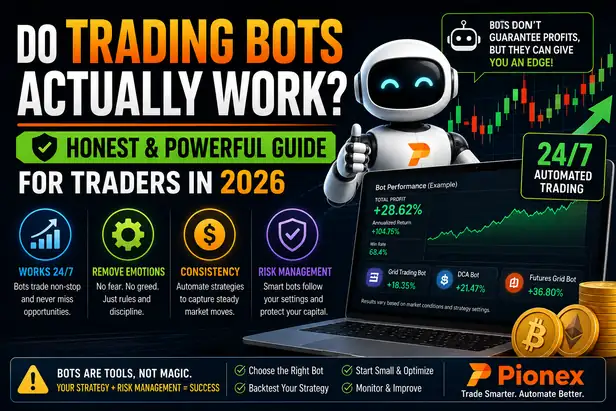
Do Trading Bots Actually Work? Complete 2026 Guide
Do trading bots actually work? Yes, but not as automatic money-making machines. A bot can monitor markets and execute predefined rules continuously, but it cannot guarantee profits. Results depend on strategy, market conditions, fees, execution, and risk controls.
Do trading bots actually work in real trading?
A trading bot is software that follows programmed instructions. It can monitor prices, indicators, volume, or signals and place or close trades automatically.
A bot can work perfectly while its strategy loses money. Automation improves consistency, not profitability. The CFTC warns that guaranteed or unusually high-return claims about automated or AI trading are red flags.
How do trading bots actually work?
Most bots follow five steps:
- Data: The system receives market information.
- Rules: It checks conditions such as RSI, moving averages, ranges, or grid levels.
- Decision: Rules determine whether to buy, sell, hold, or close.
- Execution: The bot sends orders through a connected platform.
- Controls: Settings may limit position size or exposure.
The trader still chooses the strategy.
Can trading bots actually work for making money?
They can potentially make money, but profitability is never guaranteed. A strategy can struggle when volatility, liquidity, or price direction changes.
Backtesting can help, but historical results have limitations. A system may look excellent because settings were optimized for past data, known as overfitting. Live results can differ because of fees, slippage, execution delays, and changing conditions.
Check drawdown, costs, and performance across different conditions—not only total returns.
When do trading bots actually work best?
Automation can help when a strategy has clear, repeatable rules. Bots can monitor markets continuously, execute orders quickly, and reduce emotional changes during execution.
For example, a grid bot can automate orders around predefined levels, while a DCA bot can schedule purchases. Both remain exposed to market risk.
Do AI trading bots actually work better?
Not necessarily. AI can assist with analysis or backtesting, but the label “AI” does not prove effectiveness.
AI systems can use poor assumptions, limited data, or over-optimized models. The CFTC cautions investors about automated trading schemes promising high returns.
Treat AI as a tool, not proof of profitability.
What are the biggest trading bot risks?
Trading bots face several risks:
- Market risk: Prices can move against the strategy.
- Strategy risk: Rules may stop working.
- Leverage risk: Leverage can magnify losses.
- Technical risk: Outages or API errors can disrupt execution.
- Cost risk: Fees, spreads, and slippage reduce returns.
- Scam risk: Guaranteed profits are a warning sign.
A bot still requires monitoring.
How can you test whether trading bots actually work?
Before committing significant money, understand how the system enters and exits trades. Check position sizing, loss behavior, and available risk controls.
Use backtests carefully and include realistic costs. Paper trading can help you observe the strategy before using real funds.
Do trading bots actually work for beginners?
Beginners can use bots, but they should understand the strategy first. Know what triggers trades, what fees apply, how much capital is exposed, and what the potential loss could be.
Automation does not remove financial risk. Learn the strategy before risking money.
FAQ: Do trading bots actually work?
Do trading bots actually work?
Yes. They can automate trading successfully, but automation does not guarantee profitable results.
Can trading bots make money?
They can potentially make profits, but losses are also possible. Results depend on strategy, costs, market conditions, and risk management.
Are AI trading bots profitable?
Not automatically. AI can support analysis or automation, but it cannot guarantee future market results.
Are trading bots safe?
Safety depends on the platform, strategy, security controls, and capital exposed. Automation does not remove financial risk.
Do beginners need coding skills?
Not always. Some platforms offer configurable bots, while custom systems may require programming knowledge.
Conclusion: Do trading bots actually work?
Do trading bots actually work? They work as automation tools, not guaranteed-profit machines. Their value comes from executing a defined strategy consistently, not predicting markets.
Before using one, test the strategy, account for realistic costs, understand the risks, and be skeptical of guaranteed-return claims.