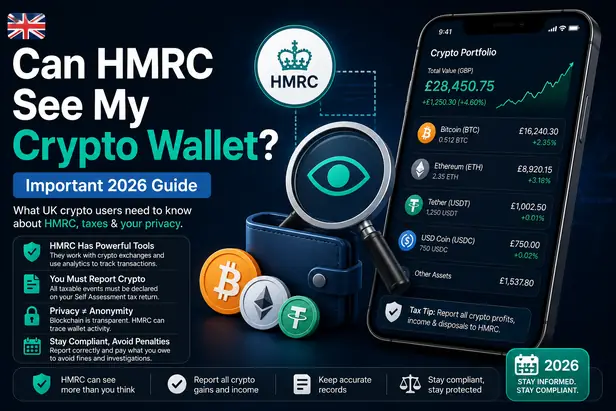
Can HMRC see my crypto wallet? HMRC may be able to obtain information about your crypto activity, depending on how you use wallets and exchanges.
A public blockchain is not automatically private because it uses wallet addresses. Transactions can often be viewed publicly, while linking an address to a person may require additional information.
From 1 January 2026, the UK’s Cryptoasset Reporting Framework (CARF) requires relevant cryptoasset service providers to collect customer and transaction information. The first reports covering 2026 activity are due between 1 January and 31 May 2027.
Can HMRC See My Crypto Wallet?
HMRC does not necessarily have a list showing every private wallet owned by every taxpayer. However, crypto activity can potentially be connected to an individual through exchanges, service providers, bank records, blockchain records, tax enquiries, and information-sharing arrangements.
A self-custody wallet is therefore not automatically invisible. If crypto moves between an exchange and a personal wallet, records may help establish a connection between the wallet and its owner.
Are Crypto Wallets Anonymous?
Many public blockchains are pseudonymous rather than completely anonymous. A transaction may show the sending address, receiving address, amount, asset, and time without displaying your name.
However, an address can potentially become associated with you through an exchange account, identity verification, bank activity, or other evidence. Once linked to an individual, its public transaction history may provide additional information.
How Can HMRC Connect a Wallet to You?
Exchange Records
When you use a crypto exchange, you may provide identifying information during registration and verification. Under CARF, relevant reporting providers must collect specified user and transaction information.
This can include your name, address, tax residence, and relevant tax identification details. Exchange-to-wallet transfers can also create records connecting activity with a user.
Can HMRC Get Information From Crypto Exchanges?
Yes. Relevant cryptoasset service providers can be subject to UK reporting and information requirements.
Under CARF, the first reporting period covers 1 January through 31 December 2026, with the first reports due from 1 January to 31 May 2027.
CARF does not create a new percentage tax simply because you hold cryptocurrency. Instead, it increases the information that relevant providers collect and report.
What About a Self-Custody Wallet?
A self-custody wallet means you generally control your own private keys, but it does not guarantee privacy from tax authorities.
Transfers between an exchange and a personal wallet may create records connecting activity with a user.
Does HMRC Automatically Know Every Wallet I Own?
Not necessarily. It would be inaccurate to say HMRC automatically knows the identity and complete holdings of every crypto wallet.
A private wallet should not be treated as permanently invisible. Evidence can include exchange records, bank transfers, blockchain activity, tax enquiries, and information-sharing.
Can HMRC Ask for My Crypto Records?
During an enquiry or review, HMRC may require relevant records and evidence. Taxpayers should maintain dates, asset quantities, GBP values, purchase costs, fees, wallet addresses, and exchange records.
Bank statements can also form part of the audit trail.
Do I Need to Declare My Crypto to HMRC?
Whether you need to report or pay tax depends on your transactions and circumstances. Selling, exchanging, giving away, or spending crypto can create Capital Gains Tax implications in relevant situations. Certain crypto received from employment, mining, or other activities may have Income Tax implications.
If you are unsure, check the latest HMRC guidance or seek qualified UK tax advice.
How Should You Keep Crypto Records?
Keep records of purchases, sales, crypto-to-crypto exchanges, transfers, deposits, withdrawals, fees, dates, GBP values, wallet addresses, and exchange statements.
Never share private keys, seed phrases, recovery phrases, or account passwords with someone claiming to represent HMRC.
Key Takeaway
Can HMRC see my crypto wallet? HMRC may not automatically know every private wallet or its complete holdings, but crypto activity should not be treated as completely invisible. Public blockchain data, exchange records, bank transactions, CARF reporting, and international information-sharing can potentially connect activity to a taxpayer.
Keep accurate records and understand your reporting and tax obligations.