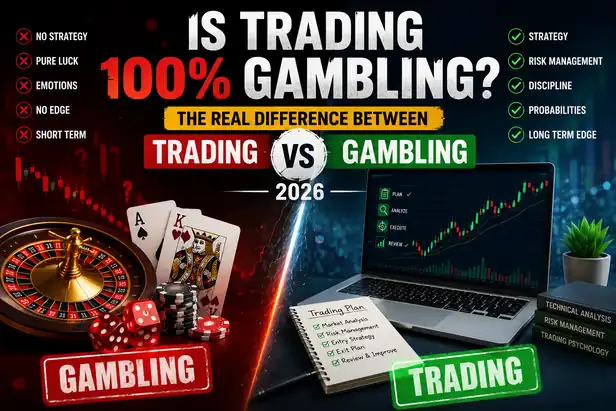
Is Trading 100% Gambling? Powerful 6-Point Guide for 2026
Is trading 100% gambling? No. Trading and gambling share uncertainty and financial risk, but they are not automatically the same activity. Trading can involve research, probability, market analysis, position sizing, risk management, and repeatable strategies.
However, random entries, excessive leverage, loss-chasing, and emotional decisions can make trading look much more like gambling. The key difference is the process behind the decision.
Is Trading 100% Gambling?
Trading is not automatically gambling because outcomes are uncertain. Financial markets are connected to businesses, economic activity, interest rates, supply and demand, liquidity, and investor expectations.
For example, buying shares gives an investor ownership in a company, while its value can change as investors reassess future prospects. The SEC warns that day trading can be extremely risky and may cause substantial losses quickly.
Why Can Trading Look Like Gambling?
Trading becomes gambling-like when decisions are driven by emotion instead of a defined process.
Common examples include:
- Entering because prices move quickly
- Increasing position size after a loss
- Trying to recover money immediately
- Following random social-media tips
- Using excessive leverage
- Trading without an exit plan
At that point, the trader is increasingly betting on an outcome rather than following a structured strategy.
Why Does Risk Management Matter?
Risk management separates disciplined trading from impulsive betting.
A trader cannot control whether the next position wins, but can control how much capital is exposed. A sensible process includes:
- Defining maximum loss before entry.
- Using appropriate position sizing.
- Avoiding unnecessary leverage.
- Setting an exit condition.
- Avoiding revenge trading.
- Keeping trading funds separate from essential expenses.
The SEC warns that day trading on margin can produce losses beyond the initial investment, while CFTC guidance highlights significant risks from leveraged speculative trading.
How Can Traders Avoid Gambling Behavior?
Use a Trading Plan
Define why you enter, what would invalidate the idea, and where you will exit.
Stop Chasing Losses
A losing trade does not create an obligation to recover money immediately. Increasing risk after losses can quickly damage an account.
Keep a Trading Journal
Record your entry reason, exit reason, position size, risk, result, and whether you followed your rules.
Control Leverage
Leverage can make small market movements have a much larger impact on account value. Higher leverage does not automatically improve trading.
Is Day Trading Gambling?
Day trading is not automatically gambling, but frequent short-term decisions can encourage impulsive behavior. Investor.gov describes day trading as extremely risky and warns that substantial losses can occur quickly.
A disciplined day trader may use predefined setups, risk limits, and detailed records. Therefore, the time frame alone does not determine whether trading is gambling-like.
FAQ: Is Trading 100% Gambling?
Is trading basically gambling?
Not necessarily. Trading can involve research, probability, strategy, and risk management. Impulsive trading can become gambling-like.
Is day trading gambling?
No, not automatically. Day trading can use structured strategies, although regulators warn that it is highly risky.
Can you trade without gambling?
Yes. Written rules, risk limits, position sizing, and a trading journal can make decisions more systematic.
Why do people say trading is gambling?
Both involve uncertain outcomes and financial risk. The key distinction is whether decisions follow a structured process or depend mainly on chance and emotion.
Can a trading strategy guarantee profit?
No. No legitimate strategy can guarantee profitable results on every trade or in every market condition.
Conclusion: Is Trading 100% Gambling?
So, is trading 100% gambling? No. Trading can involve skills, including analysis, probability, strategy, risk management, and disciplined execution. However, it can become gambling-like when decisions are driven by emotion, random guesses, excessive leverage, or loss-chasing.
The process behind the decision matters. A disciplined trader accepts uncertainty and controls exposure.
You cannot control the market, but you can control your process, position size, and risk carefully.